Research Projects
ER 24-4224: Novel functionalization of conventional sorbents for enhanced selectivity and improved concentration of (ultra)short-chain PFAS

NIH R01: Elucidating mechanisms for enhanced anaerobic bioremediation in the presence of carbonaceous materials using an integrated material science and molecular microbial ecology approach
ER 23-3593: Tailored Carbonaceous Materials as Biofilter Amendments for Per- and Polyfluoroalkyl Substances Removal in Stormwater Runoff
Novel Functionalization of Conventional Sorbents for Enhanced Selectivity and Improved Concentration of Ultrashort- and Short-chain PFAS
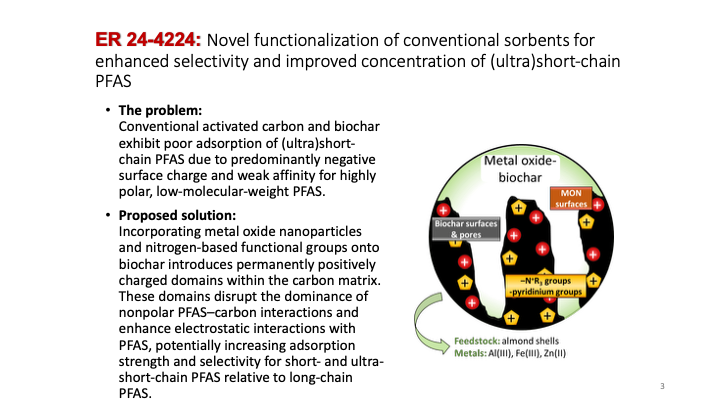
Conventional activated carbon and biochar exhibit poor adsorption of (ultra)short-chain per- and polyfluoroalkyl substances (PFAS) due to predominantly negative surface charge and weak affinity for highly polar, low-molecular-weight PFAS. Incorporating metal oxide nanoparticles and nitrogen-based functional groups onto biochar introduces permanently positively charged domains within the carbon matrix. These domains disrupt the dominance of nonpolar PFAS–carbon interactions and enhance electrostatic interactions with PFAS, potentially increasing adsorption strength and selectivity for short- and ultra-short-chain PFAS relative to long-chain PFAS.
The project aims to improve commercially available adsorbents, such as anion exchange resins and granular activated carbon (GAC), through specific surface chemistry modifications that enhance the capacity and selectivity for 18 ultrashort- and short-chain PFAS. Our team will develop and characterize metal oxide-biochar composites, evaluating for adsorption, desorption, and performance in PFAS-impacted waters. This project is in collaboration with Dr. Lee Blaney (UMBC) and Dr. Jessica Ray (University of Washington).
Elucidating mechanisms for enhanced microbial activities by PCM using an integrated material science and molecular microbial ecology approach.
A common bioremediation strategy for halogenated pollutants in groundwater and sediments is anaerobic reductive dehalogenation by organohalide-respiring bacteria (OHRB). Although effective, OHRB-driven bioremediation strategies are often incomplete in field applications. Recent research highlights PCM’s potential to promote synergistic interactions among OHRB and the auxiliary microbial community and subsequently improve OHRB-driven bioremediation efficacy. However, the underlying mechanisms of how PCM properties best support microbial network interactions, enhance OHRB performance, and promote contaminant biodegradation remain unknown.
This project aims at closing the knowledge gap concerning specific surface effects of PCM on the performance of pollutant-degrading microorganisms, especially OHRB. The central hypothesis is that key PCM properties will shape microbial community structure and drive the expression of metabolic functions associated with reductive dehalogenation processes. Elucidating positive impacts between PCM and OHRB will allow for the development of tailored PCM that foster synergistic microbial network interactions and facilitate more effective and sustainable bioremediation. We are collaborating with Dr. Tim Mattes (University of Iowa) on this project through the NIH support.
Tailored Carbonaceous Materials as Biofilter Amendments for Per- and Polyfluoroalkyl Substances Removal in Stormwater Runoff.
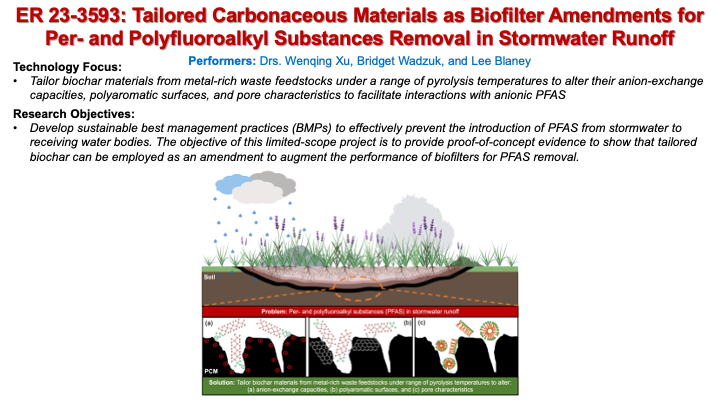
Recently, there have been increasing concerns over the discharge of stormwater containing PFAS due to the historical use of aqueous film-forming foam (AFFF) and the possible intrusion and infiltration of AFFF-impacted groundwater into stormwater systems. PFAS have also been frequently detected in stormwater runoff from residential, commercial, and industrial areas. Notably, many reported values exceeded the Environmental Protection Agency human health advisory level of 70 ng L-1. Although biofilters are one of the widely used stormwater best management practices (BMPs), current knowledge suggests that these systems may fail to remove PFAS.
The objective of this project is to provide proof-of- concept evidence to show that tailored biochar can be employed as an amendment to augment the performance of biofilters for PFAS removal. We will tailor biochar materials from metal-rich waste feedstocks under a range of pyrolysis temperatures to alter their anion-exchange capacities, polyaromatic surfaces, and pore characteristics. We will also develop strategies to covalently graft quaternary ammonium groups on selected biochar to facilitate interactions with anionic PFAS. The efficacy of these materials will be evaluated under conditions relevant to field BMP operations using bench-scale batch and column tests. To better incorporate the complexities involved with field conditions, we will perform column tests using authentic stormwater collected from a DoD facility and assess the removal of PFAS under varying dissolved organic carbon contents as well as flow dynamics that allow the soil column to fluctuate between saturated and unsaturated conditions. We are collaborating with Dr. Lee Blaney (UMBC) and Dr. Bridget Wadzuk (Villanova) on this project.
Harnessing the synergy between naturally existing PCM and sulfide for detoxifying halogenated contaminants.
Many halogenated pollutants are toxic and enter the environment as pesticides, surfactants, and industrial chemicals. These toxic pollutants are often found in sediment where PCM and sulfide naturally co-exist. My group has demonstrated that PCM and sulfide together promote the abiotic degradation of several halogenated pollutants, releasing lower toxicity products. This dehalogenation reaction represents a vast untapped resource for detoxifying pollutants as both PCM and sulfides are naturally occurring in environmental sediments. Yet, due to the complexity that arises from the heterogeneity of the PCM system in the environment, the required conditions for dehalogenation are not well understood. My group aims to employ polymer chemistry and surface characterization techniques (e.g., XANES) to understandhow the interaction between PCM and sulfide degrades these halogenated pollutants. The goal is to apply these naturally occurring reactions to produce solutions that effectively detoxify pollutants.